
Liminal Spaces: The space between rooms and words and other things you realised entering 2026…

It’s New Years Eve, you’re full of hope, anguish, and cocktails. It all feels too much, too much cigarette smoke, too much lipstick, too much superfluity. A guy beside you with sweaty palms won’t stop trying to kiss you. It all feels like an ostentatious effort to be in a “happy new year” mood.
No cosmic reset. No kings restored. No vows to gods. No booms or crackles. Just the knowledge that 365 days are gone and you’re 365 days older.
Suddenly, the year before feels obsolete, as though what was, is now faulty.
The night feels like coming to the end of a long passageway. A walkway that crept slow and held you for a time. A month-long corridor between December and January. A tunnel that announced the crossing between beforehand and thereafter. The crossing comes loud and bright, whether you’re ready or not.
You behave as if the past must be discarded for the
future to begin. Or perhaps New Years parties, soirees, bush doofs are simply how people fend off cosmic repetition—by staging a temporal doorway and daring themselves to miraculously change, to renew.
The ritual heightens you—at midnight it instructs you to look up, drink, confess, cry, kiss, and make vows you will later have to execute, and probably reconsider.
With the splitting of now from later, dread begins to rise as you sober up. Somewhere inside the stupor, you feel a visitation from your older, wiser self, asking: What is it you want, my dear?
As you gather an answer, the rehearsal of old, complicated stories wears thin. The doorway to tomorrow—to the thousands of tiny happenings of now and then, now and then, now and then—begins to open and close: pain to relief, thoughts to words, silence to laughter, desire to grief, resentment to indifference, day to night, airborne to grounded. Thoughts surface; memories weaken. Joy appears edged with the knowledge that it will end—from the top of the stairs to the base. Knowing something is over before it officially ends. Wanting less. Wanting more. Becoming someone else entirely.
You decide that the space between the two is what you prefer. You prefer to be suspended. The key half-turned before it clicks the door wide open. The second before the words leave your lips. The moment of waiting, before anything has happened. Suspended in the image, the anticipation—frozen, braced, unrealised, undiscovered. The precipice of something new, but not quite there yet. The liminal.
This idea intrigues you so you look up the meaning of the world to find that liminal comes from the Latin word “limen,” which means threshold. You google search images of what liminal spaces look like- this is what you find:
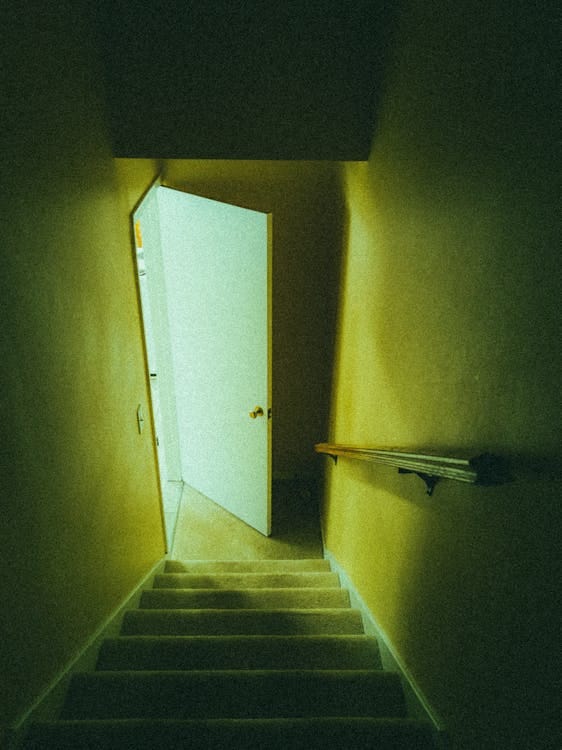
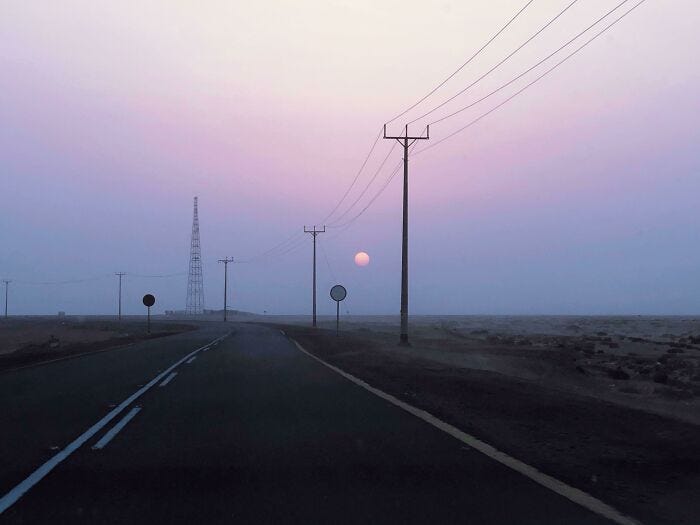
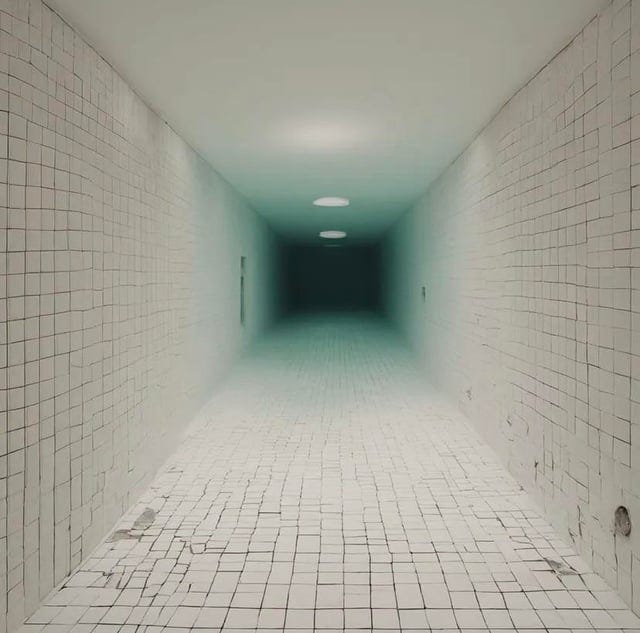
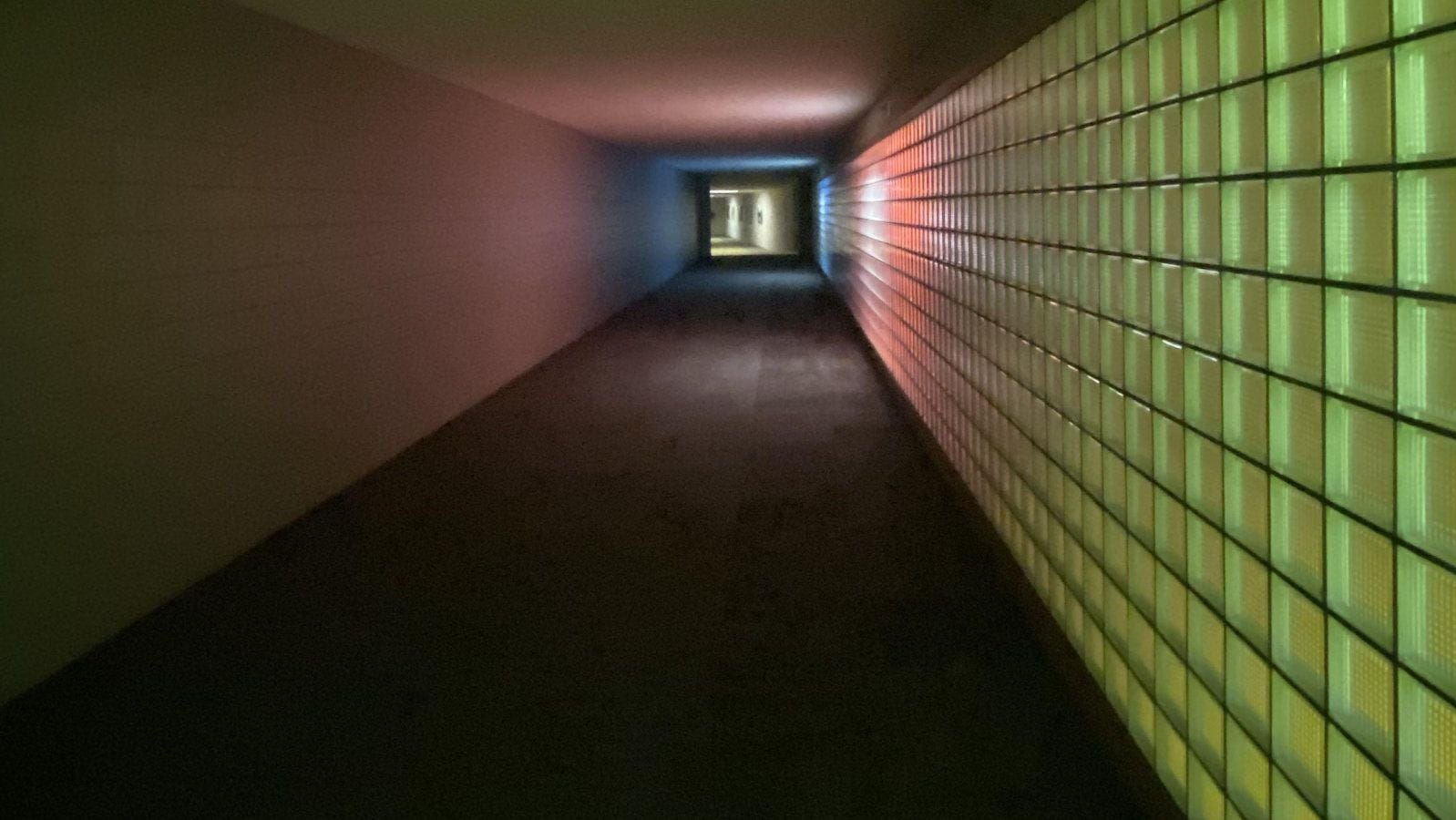
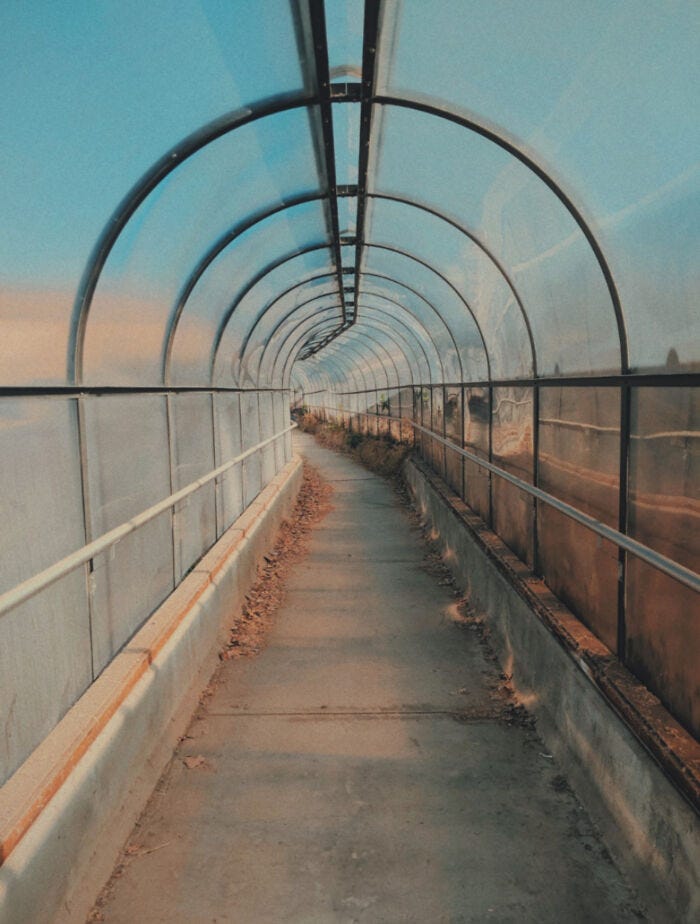
The images calm you: stairwells, roads, bridges, corridors, hotel lobbies, elevators, train stations, footpaths, piers, lookouts, spare rooms, forest edges, estuaries—all devoid of demands, expecting no one. What others find eerie, claustrophobic, or sad, you find calming, cosy, and undemanding. Here, in the liminal, you feel seen without being known. You can exist without explanation. Time behaves strangely. Attention loosens, becomes free. It reminds you how often you are caught between a longing to belong and a quieter habit of hesitating at the threshold—acquiescing out of fear of what will follow.
You discover this version of yourself in airport terminals. You eat white bread sandwiches with unassuming condiments. You buy nuts in small, expensive packets. You watch people drink beer at hours that don’t correspond to anyone’s idea of appropriate. No one talks to you. No one expects you to explain where you’re from or where you’re going. It is deeply comforting.
You sit among strangers who are also between things, all of you facing departure boards like secular altars. Announcements arrive half-heard, names of cities passing through you without consequence. Time loosens its grip. You are not late, not early—just present enough to exist. Conversation feels unnecessary. Silence becomes generous.
There is relief in being unremarkable. In being another body with a boarding pass, another person waiting. You notice how little you require in these moments: sustenance, somewhere to sit, the permission to remain unaccounted for. You enjoy the way life narrows to its essentials. Eat. Wait. Move when told.
It feels like a rehearsal for something simpler—a life without performance, without narrative. Just you, suspended in transit, nourished by modest things, quietly enjoying the rare freedom of not having to arrive yet.
Everything that follows this, so violent it almost feels impolite; at others, so dull it haunts. And the in-between remains patient and unsuspecting, something entrusted to you—like a mother’s embrace. This is what the month-long corridor between December and January became: imperturbable, sympathetic.
Again, your older, wiser self asks: What is it you actually want? A liminal space to rest — but what about everything else?
After some thought, you realise that the aesthetics of liminality, or its undemanding nature, can’t be the answer. The liminal can’t be all you want.
It isn’t the stairwells, airport terminals, roads, or forest edges that are calming, cosy, and undemanding. Nor the footpaths, piers, and estuaries that feel patient, unsuspecting, entrusted — imperturbable and sympathetic. What calms you is that these spaces invite a kind of rest you forget to allow yourself elsewhere.
Outside them — in crowds, boardrooms, offices, schools, bedrooms, arguments, break-ups, supermarkets, friend groups, communities — you begin to notice how many places you have decided are wary of improvisation, prone to hesitation, afraid of risk. In the fullness of experience, your radar is overwhelmed as you try to take everything in at once.
Crossing the threshold invites out the parts of you that liminal spaces keep quiet. Visibility without exit. Interpretation without warrant. Closeness without intimacy. The unspoken demand of a continuous identity performance — and with it, comparison and self-doubt. Crossing the threshold has you feel trapped in expectation.
So, you crave the roads of travel that come before it all. Before the exposure. Before the shame.
And yet —
These liminal spaces are reminders of the sympathy, understanding, and compassion your surface self needs from your inner heart and mind to get by. You realise that, despite everything, you are already doing your best—surviving, trying to maintain control in a restless, uncontrollable world that continues to surprise you.
Yet no matter how comfortable and cosy tunnels, pathways, and corridors feel, life outside persists, insisting that you experience all of it.
Life outside asks you to fess up — to expose and bear your scars, asymmetries, mis-phrased idioms, soiled clothes, uneven complexion, your afraid-ness, and all the reasons you feel crazy, broken, or too much. Because that is always what life asks of you.
It asks you to own what you are doing with your life. To receive the knowledge of your eventual demise. To admit the scarcity of your money. To recognise your inconsequentiality within the infinity of the universe.
It asks you to notice the pain you cause, the questions you leave others with, the risks you incite, the grounding or activation you create, the ways tension releases or tightens. To get honest about your drifting attention, your unsteadiness, and your unwillingness to stay. As well as the ways you make someone else want to drift, feel unsteady, or race away.
And it also asks that you be okay with all of it. All these things only become issues if you are in denial of them. Sure, they aren’t ideal, but they are life.
You realise that to truly belong outside of the liminal, you must disown, hide, or avoid none of it. You must possess a willingness to pass through the barriers of unpleasant emotions and claim your true place. To do this, you must move past mere survival — past the expectations of what you are told to want, to be, to say, or to feel. Past the lies about what you think you ought to be in the classroom, the office, the luncheon, or the dinner party.
You come to terms with this “letting go and letting be” when you read David Whyte’s essay in Consolations II. He writes:
“We are each made in such a profoundly particular, alchemical way that the very particularity of what we have to offer as individuals is beyond what our everyday minds can recognise. The particularity of what we are imagining cannot be comprehended by the surface mind, whose job is to name, categorise, and smooth things over into generalities. To get down to this essentiality in each of us necessitates an undoing of our surface persona and a willingness to experience a more moveable, creative world inside — a world resistant to easy names, one we only misperceive as eccentric and slightly mad.”
It is our surface selves that try, in vain, to suffocate this unavoidable truth. In doing so, we become rigid, fearful, frozen when confronted with the difficult, constantly moving, overwhelming world. If we base our lives on defending against these wild, chaotic forces within us, we become a threat to ourselves — from the inside out. In the pursuit of immunity, in trying to resist the very vitality that makes us human, we risk becoming bland, inert, even dead.
You suddenly realise that the only way to stop living in the in-between — running, avoiding, waiting — is to finally let others be disappointed by you. Let them wish you were quieter, lighter, easier, more conversational. Let them wish you didn’t exist. And exist anyway.
Your wise self whispers:
“Because, baby, you’re far better off being a disappointment to others than being a quiet, distant, dulled replica of yourself. What we perceive as crazy inside us can be serious, even frighteningly pointed in its approach to life and in the expression of its own powers. But you need not be afraid, baby — you are not crazy. The brave thing is to let a little wildness have its way with you.”
This, you suppose is your ultimate perpetual liminal space- the space where you are yet to open the door to all that you are. A state of not choosing. Of not turning the key to unlock the door. Of not uttering the words you so desperately want to. Of not screaming when you’re mad. Of not crying when you’re hurting. Of staying put when you know you ought to move. Of hiding your scars, asymmetries, mis-phrased idioms, soiled clothes, uneven complexion, your afraid-ness, and all the reasons you feel crazy, broken, or too much. Because until you let these things spill over the edge of your surface self, you are liminal.
So, turns out new year’s wasn’t about cocktails or superfluity, booms or crackles, or even the knowledge that you are 365 older than January 1, 2025, it was about taking a moment to talk to your wiser self, to step back from keeping pace, so you can take inventory of what drains you—and what fuels you. Of what you really want. To choose all the ways you wish to enter—and exit the threshold again and again and again. Make those difficult decisions about the shape you want your life to take, with an eye to being resourced enough for your visionary capacity to serve life, rather than fearing it.
The only vow you make this year, the only resolution you have it to every day walk through your cosy liminal spaces, down paths, roadways and tunnels to see them as channels into your more beautiful life; a world that recognises your brilliance: a brilliance that enlivens both our own life and other’s. To keep walking through the tunnel to finally exit the threshold, beyond the in between, into your wild and precious life on the other side.
Happy New Year everyone.
May we all step through our preciously contained thresholds and into the more beautiful world that lives just beyond it.
Thank you for reading Beautiful Ache.
Please subscribe, restack or like—Your support keeps me going.
Lish xx
this articulated my love for liminal spaces in a way i didn’t know how to explain, not as avoidance, but as refuge. the reminder that rest is something we’re allowed to bring back with us felt especially powerful. thank you for writing this.
Really like it! New Year’s Eve not as a "cosmic reset," but as a month-long temporal doorway where people ritualize sociality (kisses, vows, drinking) to fend off the fear the passage of time. I never saw it form this perspective!